


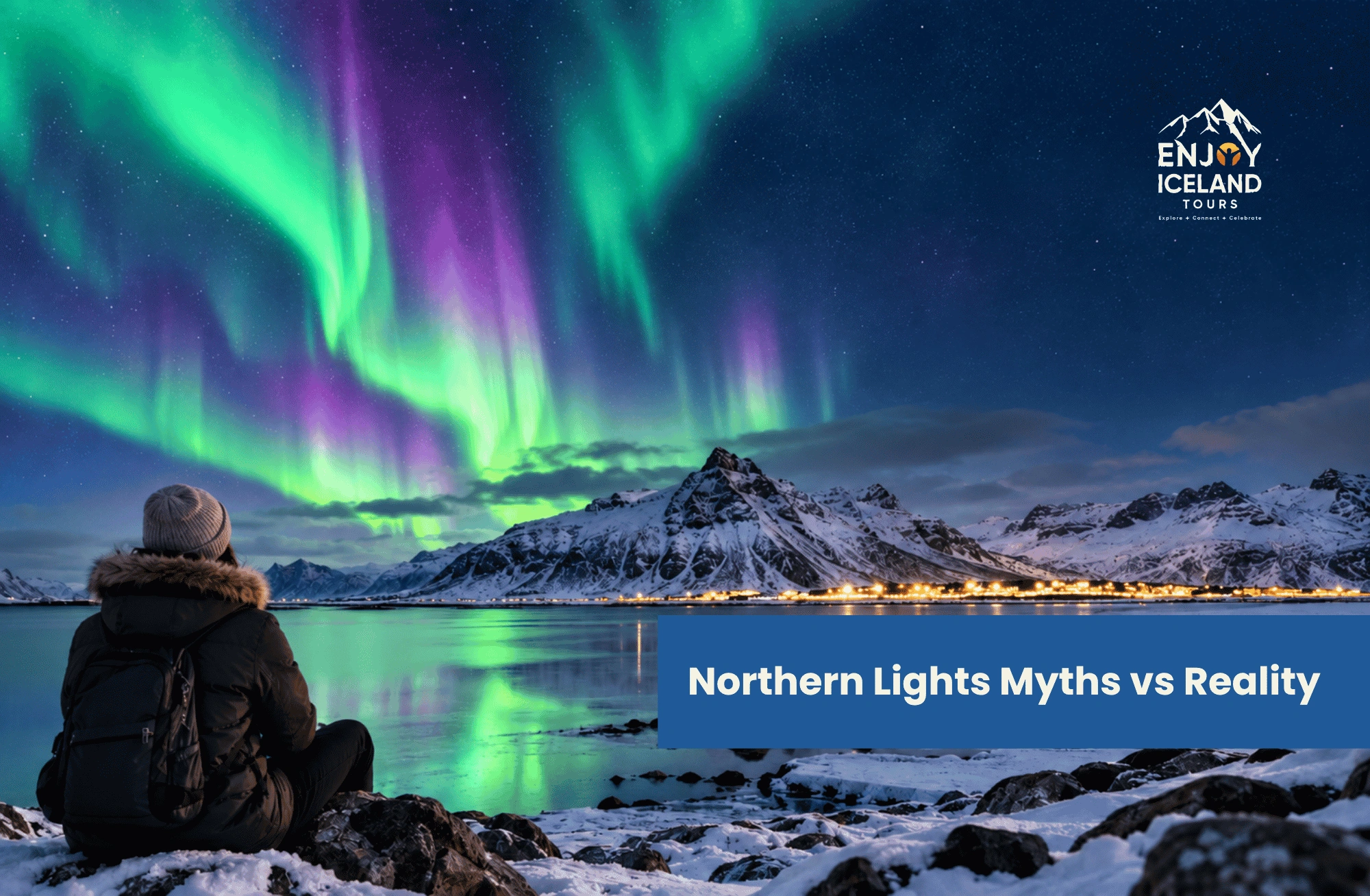
Northern Lights Myths vs Reality: What Actually Affects Your Chances of Seeing Them
Northern Lights Myths vs Reality: What Actually Affects Your Chances of Seeing Them
Seeing the northern lights is one of the biggest draws of an Iceland trip, and also one of the most misunderstood parts of planning one. A lot of what circulates online about guaranteed sightings, moon phases, and the right camera settings doesn't hold up once you look at what actually determines whether you'll see them on a given night.
Quick answer: Seeing the northern lights in Iceland depends on three things lining up on the same night: real darkness, clear skies, and enough solar activity to produce a visible display. No tour, app, or forecast can guarantee a sighting, since even strong solar activity is invisible behind cloud cover. The most reliable way to improve your odds is staying long enough in the country to have multiple chances, and keeping your evening plans flexible enough to chase clear skies rather than a fixed schedule.
Myth: You're Guaranteed to See Them if You Book a Tour
This is the most common misconception, and it's worth addressing directly. No operator, however experienced, can guarantee a sighting on any given night, because the aurora depends on conditions no one controls: cloud cover, solar activity, and genuine darkness all have to align at the same time. What a good tour actually offers isn't a guarantee, it's a better shot at being in the right place if conditions do line up, since a guide watching the forecast can move toward clearer skies rather than sitting in one fixed spot.
Be cautious of any claim that promises a sighting outright. It's a sign the claim is marketing rather than an honest description of how the aurora actually works.
Myth: The Northern Lights Only Happen in Winter
The aurora itself is present year round. It's a phenomenon caused by solar particles interacting with the atmosphere, and that doesn't stop happening in summer. What changes seasonally is darkness, not the aurora. Iceland's summer nights stay too bright to see it, which is why the visible season generally runs from late August through late April, not because the lights disappear, but because the sky doesn't get dark enough the rest of the year to notice them.
Myth: You Need to Travel Far Outside the City to See Anything
Light pollution does make a real difference, and a spot away from bright city lighting will show a clearer, more vivid display than standing under a streetlamp downtown. But this gets overstated into an idea that you need to drive hours into the wilderness for any chance at all. A strong display is visible from a wide area, including spots just outside a city's brightest core, if the sky is dark and clear. The bigger factor is usually cloud cover and darkness timing, not distance for its own sake.
Myth: A Weak Forecast Means Nothing Will Happen
Aurora forecasts often use the Kp index as one measure of geomagnetic activity, but it's a rough guide rather than a precise prediction of what you'll see from a specific location. A modest forecast can still produce a visible, worthwhile display if the sky is clear and dark, while a stronger forecast is useless if it's raining or overcast. Cloud cover is often the more immediate factor for viewing from Iceland, and it can change significantly from hour to hour on any given night.
Myth: You Need a Full Moon or No Moon at All
Moonlight is a minor factor, not a major one. A bright full moon can slightly wash out a faint aurora the same way it dims faint stars, but it doesn't prevent a strong display from being visible, and plenty of memorable sightings happen with a moon in the sky. It's worth knowing about, but it shouldn't be the deciding factor in when you plan a trip.
Myth: The Northern Lights Are Always Green
Green is the most common color because it comes from oxygen at the altitude where most aurora activity happens, but displays can also show pink, purple, and red, particularly during stronger activity or at different altitudes. Photos often show more color saturation than the naked eye perceives in real time, since long camera exposures gather more color information than human eyes do in low light, which is part of why photos and in-person experiences can look different from each other.
Myth: One Night Is Enough to Plan Around
If seeing the aurora matters to your trip, planning around a single fixed night is the riskiest approach available. Weather and solar activity are both unpredictable more than a day or two out, so a longer stay with multiple evening opportunities gives meaningfully better odds than one tightly scheduled attempt. This is one of the more useful, if less exciting, pieces of advice: time and flexibility matter more than any single tip about timing or technique.
What Actually Improves Your Odds
Strip away the myths, and the real factors are straightforward: genuine darkness (so outside the bright summer months), a clear or mostly clear sky, some level of solar activity, and enough nights in the country to have more than one chance. None of these can be forced individually, but a flexible schedule that can respond to conditions as they change is the closest thing to a real advantage that exists.
This is exactly where a private Northern Lights tour differs from a fixed nightly departure. A guide tracking the forecast that evening can choose where to go based on where the sky is actually clearing, rather than running the same route regardless of conditions. It's not a guarantee, nothing is, but it's a genuine improvement over guessing on your own or following a schedule set weeks in advance.
If your trip includes multiple days, pairing a Northern Lights evening with a daytime Golden Circle or South Coast tour means the trip delivers regardless of what happens after dark on any given night.
Frequently Asked Questions
Can a tour guarantee I'll see the northern lights?
No. The aurora depends on darkness, clear skies, and solar activity all lining up on the same night, none of which any operator controls. A good tour improves your odds by chasing clear skies, but it can't guarantee a sighting.
Do the northern lights only appear in winter?
The aurora happens year round, but Iceland's summer nights stay too bright to see it. The visible season runs roughly from late August through late April, when there's enough real darkness at night.
Do I need to be far from the city to see the northern lights?
Distance from light pollution helps, but it's not the deciding factor. Cloud cover and genuine darkness matter more than how far outside a city you are, and a strong display can be visible from areas closer to town if the sky is clear.
Are the northern lights always green?
Green is the most common color, but displays can also show pink, purple, and red depending on solar activity and altitude. Photos often appear more vivid than what's visible to the naked eye, since camera exposures capture more color than human eyes do in low light.
How many nights should I plan for if I want to see the northern lights?
More than one, if possible. Weather and solar activity are hard to predict more than a day or two ahead, so multiple evenings in the country give meaningfully better odds than a single scheduled attempt.